

An aerosol-aware Lagrangian case study ensemble for LES and SCM based on the Cold-Air Outbreaks in the Marine Boundary Layer Experiment (COMBLE)
Authors
Florian Tornow — Columbia University/NASA Goddard Institute for Space Studies *
Israel Silber — Pacific Northwest National Laboratory
Ann M. Fridlind — Goddard Institute for Space Studies
Jeramy L Dedrick — University of California San Diego
Abigail Williams — Scripps Institution of Oceanography
Lynn M Russell — Scripps Institution of Oceanography
Benjamin E Swanson — Colorado State University
Paul J. DeMott — Colorado State University
Andrew Ackerman — NASA - Goddard Institute for Space Studies
Bart Geerts — Department of Atmospheric Science, University of Wyoming
Category
High-latitude clouds and aerosols
Description
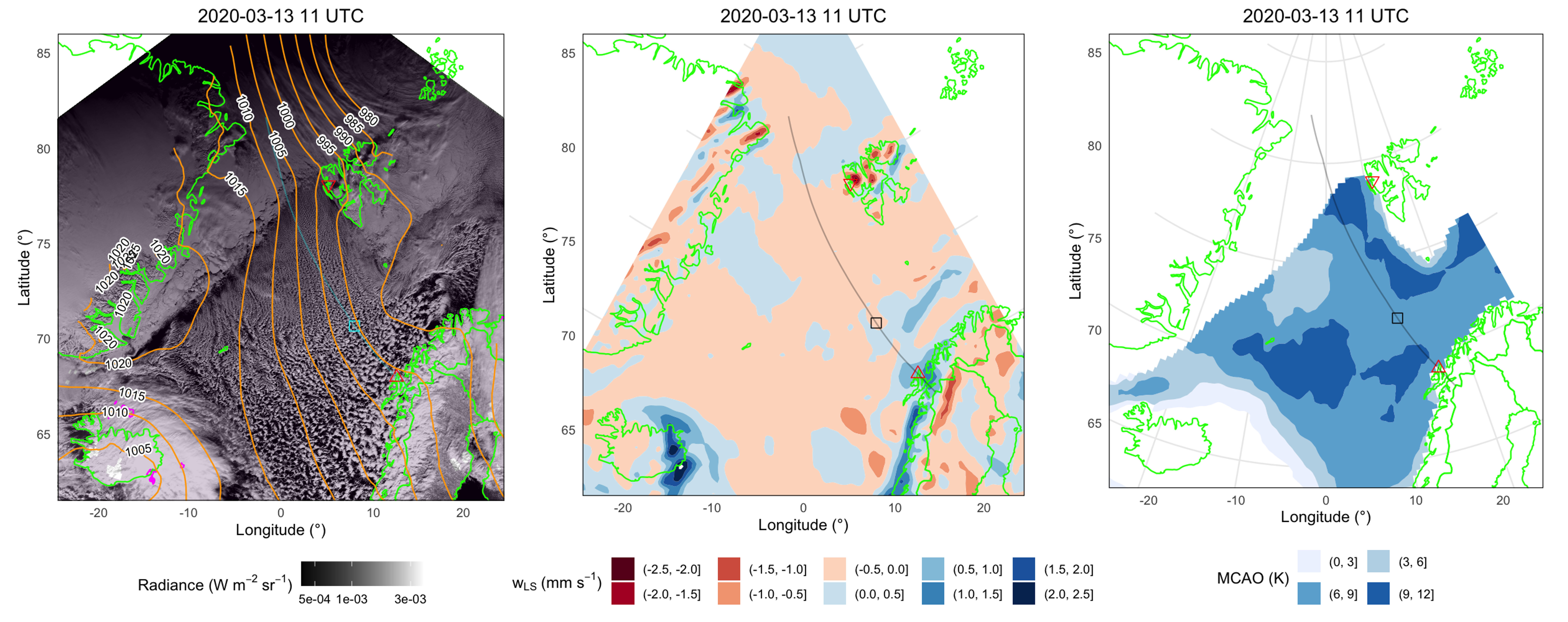
Recent development of the ModelE3 Earth system model at NASA GISS relied heavily on a set of case studies run side-by-side with a large-eddy simulation (LES) code and ModelE3 in single-column model mode, including a widely simulated Arctic cold-air outbreak (CAO) Eulerian case study based on the Mixed-Phase Arctic Cloud Experiment (M-PACE). However, none of the cases included an aerosol specification sufficient to predict ice nucleation from aerosol properties nor interactions between aerosol and cloud processes, such as cloud condensation nuclei (CCN) and ice-nucleating particle (INP) reduction via collision-coalescence and precipitation. Here we describe the process of selecting a small ensemble of Arctic CAO Lagrangian case studies from the recent COMBLE field campaign over the North Atlantic based on a combined analysis of observed and reanalysis meteorological and aerosol conditions on the Norwegian coast at Andenes and along upwind trajectories. One case study period is shared with an upcoming LES model intercomparison project. Initial LES results are compared with reanalysis and observed thermodynamic soundings, cloud structural properties observed by Ka-band zenith radar, and microwave radiometer retrievals of liquid water path. First SCM results are compared with LES using fixed hygroscopic and ice-nucleating aerosol fields. We seek to roughly bound the impacts of uncertainties related to prediction of surface turbulent fluxes, cloudy boundary layer CCN and INP budgets, and secondary ice production.
Lead PI
Ann M. Fridlind — Goddard Institute for Space Studies